.png)

Owner Occupied Loans in Australia

Key Characteristics of Owner Occupied Loans in Australia
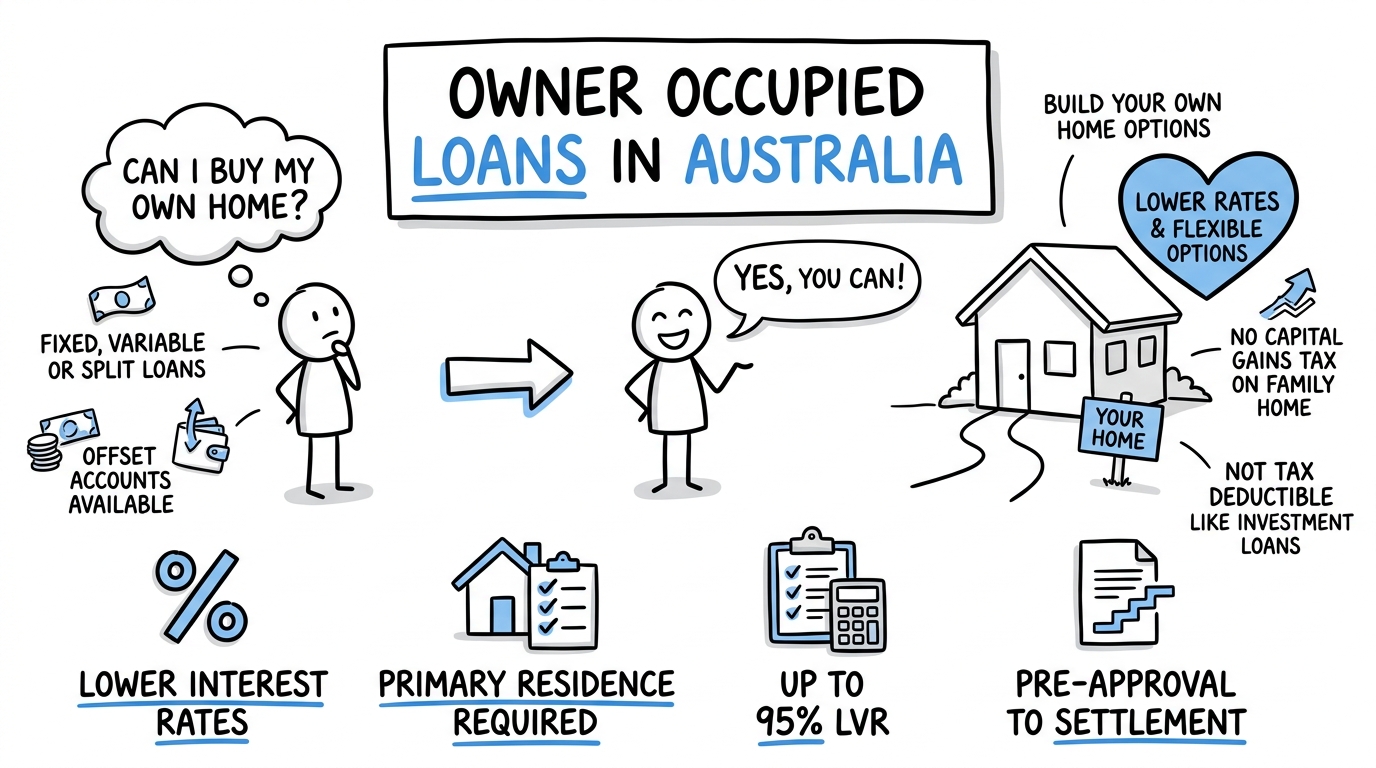
Primary Residence Requirement
You must genuinely intend to occupy the property as your main home. This is verified during the application process and must remain true for the loan's duration.
Competitive Interest Rates
Lenders typically offer lower interest rates for owner-occupied loans compared to investment property loans, reflecting the lower perceived risk.
Higher Loan-to-Value Ratios (LVR)
Many lenders will provide loans up to 95% of the property's value for owner-occupiers, whereas investment loans often max out at 80–90%.
Flexible Repayment Options
Principal and interest payments, interest-only options, and flexible redraw facilities are typically standard features.
Tax Implications
Unlike investment loans, the interest on owner-occupied mortgage payments is not tax-deductible in Australia.
Capital Gains Tax Exemption
The family home exemption means you won't pay capital gains tax when selling your primary residence.
Types of Owner Occupied Loans Available in Australia
Fixed Rate Loans
Fixed rate loans lock in your interest rate for a predetermined period—typically 1–5 years in Australia. This provides budgeting certainty and protects you from rate rises. However, once the fixed period ends, you'll face a potential rate adjustment at the reversion rate.
Variable Rate Loans
Variable rate loans fluctuate with market conditions and the Reserve Bank of Australia's (RBA) official cash rate decisions. While they offer flexibility and potentially lower starting rates, your repayments can increase if rates rise.
Split Loans
Split loans divide your mortgage into two portions—typically one fixed and one variable. This strategy allows you to balance the certainty of fixed rates with the flexibility of variable options.
Offset Account Loans
Offset accounts are transaction accounts linked to your loan. The balance in the offset account reduces the amount on which interest is calculated, potentially saving you significant interest over time while maintaining access to your money.
Construction Loans
If you're building your own home, construction loans provide staged drawdowns as the building progresses, converting to a standard loan once construction is complete.
The Application Process: Step-by-Step
Step 1: Pre-Approval
Begin by obtaining a pre-approval (or "in principle" approval). This indicates how much a lender is willing to lend based on your financial circumstances, without committing you to any specific property.
Step 2: Property Selection and Offer
Once you've found your ideal home, you'll make an offer. Having pre-approval strengthens your negotiating position with the seller.
Step 3: Formal Loan Application
Upon offer acceptance, you'll submit a formal application with detailed property details.
Step 4: Assessment and Valuation
The lender arranges a professional valuation to confirm the property's value and assess its suitability as security for the loan.
Step 5: Unconditional Approval
Once the valuation is satisfactory, you'll receive conditional approval—subject to final verification of employment and finances.
Step 6: Settlement
After final checks, you receive unconditional approval. Your solicitor or conveyancer handles settlement, transferring funds and completing legal documentation.

FAQ`s
Most lenders require a minimum 5% deposit. However, the most common benchmark is 10-20%. If your deposit is less than 20%, you'll need topay lenders mortgage insurance (LMI). Some lenders offer 95% LVR products,though these typically come with higher interest rates or stricter eligibility criteria. First-home buyers in some states may access government schemes that reduce deposit requirements.
Yes. A co-borrower (typically a spouse or partner) will have their income and obligations included in the application, improving serviceability. A guarantor provides security—their property supports the loan—but doesn't need to be on the title. Lenders assess both parties financial positions, so having a strong co-borrower or guarantor can improve your chances of approval or borrowing capacity.
LMI protects the lender (not you) if you default on the loan. It's required when your LVR exceeds 80% (deposit less than 20%). LMI cost typically ranges from 2-6% of the loan amount, added to your loan balance. It's a one-time cost paid upfront.While it increases your total borrowing, it allows you to purchase sooner witha smaller deposit.
Fixed rate loans lock in your interest rate for a set period(usually 1-5 years), providing payment certainty. If rates rise, your payments remain unchanged. However,if rates fall,you don't benefit unless you refinance (which may incur fees). Variable rate loans move with the RBA's official cash rate—your payments change when rates change. Variables typically start lower but carry interest rate risk. Many borrowers use split loans to balance both strategies.
The First Home Super Saver Scheme (FHSS) allows first-time home buyers to withdraw voluntary contributions and earnings from superannuation to help fund a home deposit.You can contribute up to $15,000 per financial year, up to a total maximum of $50,000 across all years.
Maximum withdrawal is capped at $50,000 per person (or $100,000 per couple).
When your fixed period expires, your loan typically reverts to the lender's revert rate—often higher than the initial fixed rate. You have several options: accept the revert rate, refinance to a new fixed period with another lender, switch to a variable rate, or use a split loan approach. It's crucial to plan ahead during the fixed period and review your options before the reversion date.
An offset account is a transaction account linked to yourloan. The balance in this account is 'offset' against your loan balance for interest calculation purposes. For example, with a $300,000 loan and $50,000 in your offset account, you only pay interest on $250,000. This effectively reduces interest without formally paying down the loan, preserving funds for emergencies while saving significantly on interest over time.
Beyond the loan itself, typical costs include: legal/conveyancing fees ($1,000-$2,500),lenders mortgage insurance (if required), stamp duty (varies by state,typically 3-6% of purchase price), building and pest inspection ($400-$800),and settlement costs. First-time buyers in some states receive stamp duty concessions or exemptions. It's essential to budget for these additional costs when calculating your total purchase amount.
Most owner-occupied loans operate on principal and interest(P&I) repayment, where each payment reduces your loan balance. Some lenders offer interest-only (IO) periods—typically 5 years—where you pay only interest with no principal reduction. P&I is more common for owner-occupiers as it builds equity faster. Interest-only is more common for investment loans for tax efficiency. Many loans allow flexible repayments and extra payments without penalty.