.png)


Home loan eligibility: what Australian lenders really check

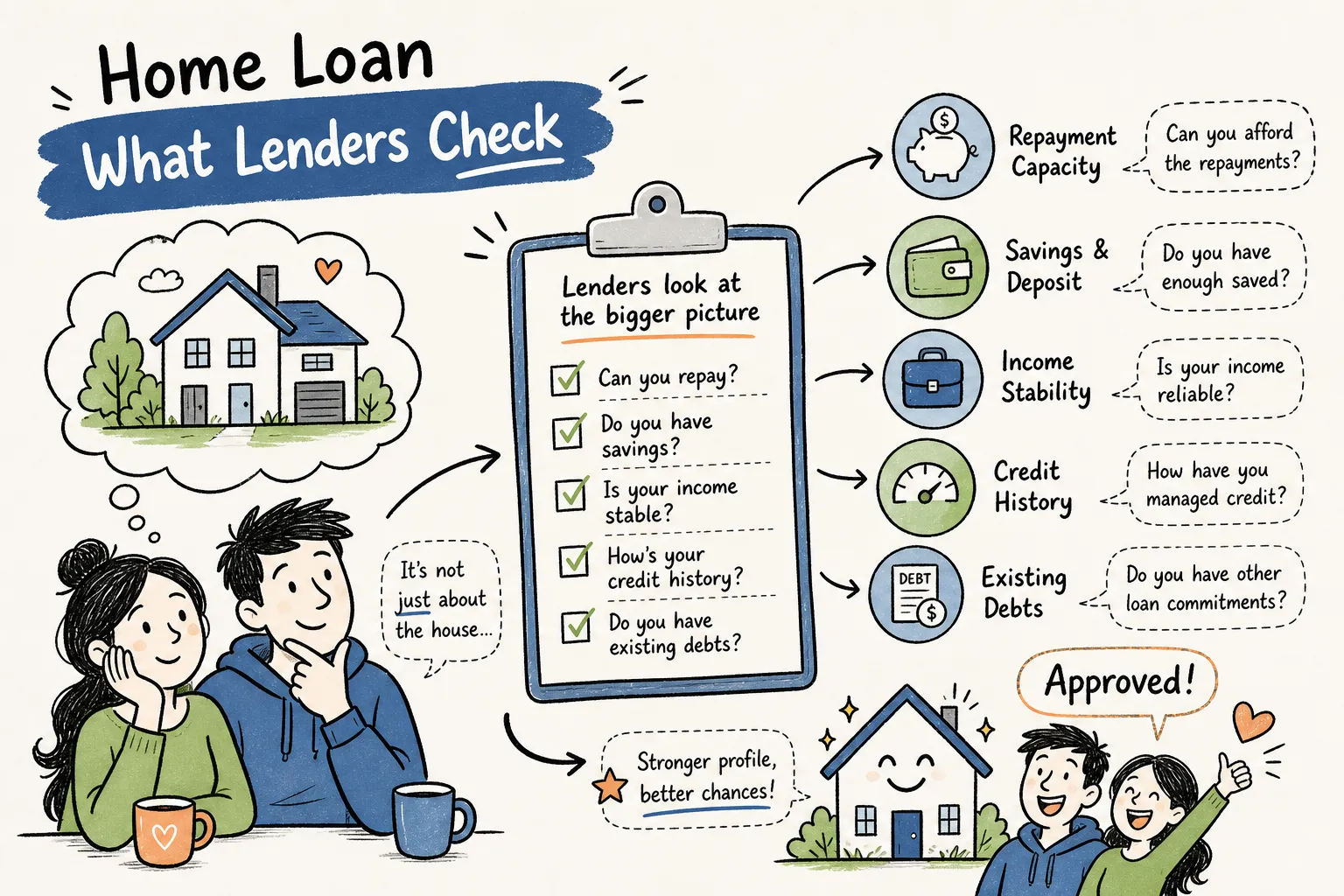
Home loan eligibility: the five factors lenders check
Major banks and non-bank specialists alike run through the same assessment checklist. The weighting may differ slightly between institutions, but the five factors below are non-negotiables across the board.
Income and loan serviceability
Lenders assess your gross income against your total monthly expenses to confirm you can service the loan. What many borrowers don't realise is that the assessment doesn't use the actual interest rate on your loan. Under APRA's serviceability buffer, lenders must test your repayments at 3% above the actual loan rate. This single requirement significantly reduces the borrowable amount compared to what most people expect when they run the numbers themselves. The serviceability buffer is explained in more detail in the section below, including what it means for your borrowing ceiling.
Credit score and repayment history
Lenders look for a credit profile that signals reliability: no recent defaults, a consistent repayment history on existing obligations, and a score that sits within their acceptable range. Major banks typically decline applications where the credit score is below 500 or where unpaid defaults remain on the file. That said, a lower score doesn't automatically disqualify a borrower. Non-conforming lenders assess applications on their merits, taking a broader view of your financial stability rather than relying solely on a single score.
Employment type and how long you've been in your role
PAYG employees typically need a minimum of three months in their current role, supported by payslips. Self-employed applicants face a higher documentation bar: two years of personal and business tax returns, plus ATO Notices of Assessment. Casual and contract workers attract additional scrutiny, with most lenders wanting six months of bank statements to demonstrate consistent income. The longer and more stable your employment history, the more straightforward your application becomes.
Existing debts and living expenses
This is the factor that catches the most borrowers off guard. Credit card limits, personal loans, car loans, and HECS/HELP debt all reduce your borrowing capacity, even if you carry no balance on your cards. Lenders commonly treat the full credit limit as a potential liability, since you could draw it down at any time, and many model a minimum repayment against that full limit in their serviceability assessment. A $15,000 credit card limit you never use can still reduce your borrowing capacity meaningfully.
How lenders calculate how much you can actually borrow
Eligibility and borrowing capacity are related but distinct. You might be eligible for a loan in principle while still being limited in how much a lender will actually approve. Here is how lenders arrive at that number.
The serviceability buffer and what it means for your borrowing ceiling
As confirmed by APRA, the serviceability buffer remains at 3% and has been unchanged since October 2021. In practical terms, if the current loan rate is 6%, the lender stress-tests your repayments at 9%. On a $600,000 loan over 30 years, the difference between repayments calculated at 6% versus 9% is substantial, the buffer can reduce your maximum borrowable amount by tens of thousands of dollars compared to a simple rate-based estimate. The buffer exists to ensure you can still manage repayments if rates rise sharply, which is a reasonable safeguard, but it does mean your actual borrowing capacity is lower than an unadjusted calculation would suggest.
Debt-to-income ratio and where the caps sit
Under APRA's DTI framework, which came into effect in early 2026, debt-to-income ratio limits now play a formal role in lending decisions. Most major lenders cap loans at approximately six to eight times taxable income, with APRA restricting banks to issuing no more than 20% of new loans to borrowers with a DTI of 6 or higher. To put that in practical terms: a borrower with a taxable income of $90,000 is looking at a rough ceiling of around $540,000 at a 6x multiple, before the serviceability buffer is applied. Individual bank maximums vary, ANZ and NAB, for example, sit at different thresholds according to their published lending policies, which is one reason two lenders can return very different approval amounts for the same applicant. Check the current published policy for any lender you're considering, as these limits are reviewed periodically.
How lender policies vary and why your number differs between institutions
Each lender applies its own expense benchmarks and income shading policies. Some lenders discount rental income or overtime pay, while others accept it in full. Living expense benchmarks differ: one institution may apply a higher standard monthly expense figure than another for a household of the same size, which directly reduces the surplus income available for loan repayments. This variation is exactly why running a single online calculator gives you a rough directional number rather than an accurate lending assessment.
Deposit size, LVR, and lenders mortgage insurance
Your deposit size determines your loan-to-value ratio, which in turn affects both your home loan eligibility and the cost of borrowing. Understanding this relationship helps you make smarter decisions about when to apply.
The 20% benchmark and when LMI applies
The 80% LVR threshold is the industry standard cut-off for lenders mortgage insurance. When your deposit is less than 20% of the purchase price, most lenders require LMI to protect themselves against default risk. It's worth being clear on what LMI does and doesn't do: it protects the lender, not you, and the premium is not a small cost. On a $500,000 property with a 5% deposit (95% LVR), estimated LMI premiums in 2026 sit between $16,000 and $19,000. At a 10% deposit (90% LVR), that range falls to around $8,000 to $14,000. LMI can be capitalised into the loan rather than paid upfront, but either way it adds to the total cost of borrowing. For current LMI premium rates and examples, see specialist LMI guides that break down typical costs by LVR.
Low-deposit options and government scheme pathways
Not every low-deposit buyer needs to pay LMI. The First Home Guarantee allows eligible first-home buyers to purchase with a 5% deposit and no LMI, with the government guaranteeing up to 15% of the loan value. Following the October 2025 expansion, income caps were removed entirely, meaning there's no means testing, and property price caps increased significantly. The current NHFIC property price caps vary by state and city, check the latest figures directly with NHFIC or your broker, as these are updated periodically. The Family Home Guarantee extends a 2% deposit option to eligible single parents, with the same no-LMI structure. For buyers with family support, a guarantor loan using a parent's equity remains the only genuine zero-deposit pathway.
What "genuine savings" means and why it matters
Most lenders require at least 5% of the purchase price to be genuine savings: funds held in your name for a minimum of three months. A lump-sum gift from a family member, a tax refund, or the recent sale of an asset doesn't automatically satisfy this requirement. For loans above 85% LVR, lenders want documented evidence that at least that 5% threshold has been sitting in your account and building consistently. First-home buyers frequently miss this detail and find their application stalled, not because of income or credit, but because their savings history doesn't meet the genuine savings definition.
Documents lenders need to verify your application
Getting your paperwork ready before you apply prevents unnecessary delays and reduces the risk of a lender returning with follow-up requests after submission. The following is organised by employment type.
Proof of income by employment type
- PAYG employees: Two to three recent payslips, a PAYG payment summary or ATO Income Statement, and three months of bank statements showing salary credits.
- Self-employed applicants: Two years of personal and business tax returns, corresponding ATO Notices of Assessment (within the last 18 months), and business financial statements including profit and loss.
- Casual or contract workers: Six months of bank statements demonstrating consistent income deposits, plus an employment contract where available.
Identity and savings verification
Identity verification requires one primary document: an Australian passport or driver's licence. For savings, lenders want three to six months of bank statements showing a consistent deposit pattern. For higher LVR loans above 85%, the statements need to demonstrate that at least 5% of the purchase price has been accumulating over that period rather than arriving in a single recent transfer. A broker's value here is practical: they'll review your documents before submission and flag anything that could cause a delay or a conditional approval, far better than discovering the gap after lodgement.
What to do if you fall short on any eligibility factor
Falling short on one factor isn't the same as a flat-out no. Each factor is addressable with the right strategy and a realistic timeline.
Strengthening your credit position
Pull your credit report before applying. Errors appear more often than people expect, and disputing an incorrect listing may be resolved in weeks to months depending on the credit reporting provider, refer to ASIC's MoneySmart guidance or contact your credit bureau directly for the relevant dispute process. Pay down any overdue accounts and avoid applying for new credit in the three months before lodging a home loan application. Every new credit enquiry leaves a mark on your file that lenders can see. If your score is low due to past difficulties rather than active defaults, non-conforming lenders will often assess your current financial stability rather than relying on the score alone.
Reducing debt and freeing up serviceability
Closing unused credit cards has a direct and measurable impact on borrowing capacity. Because lenders count the full credit limit as a liability, reducing a $10,000 card limit can add meaningful borrowing room, often several thousand dollars of additional capacity depending on the loan amount and interest rate. Paying down personal loans achieves a similar result. The priority should be eliminating high-limit facilities you don't need before you apply, rather than simply carrying a zero balance on them.
Building your deposit and savings history
Automating a regular savings transfer to a dedicated account each payday is the most effective way to demonstrate a genuine savings pattern to lenders. Three to six months of consistent contributions builds the documented history that satisfies the genuine savings requirement. If you're eligible to make voluntary contributions through the First Home Super Saver Scheme (FHSSS), you may also be able to withdraw those contributions towards your deposit, refer to the ATO's FHSSS guidance for current eligibility rules, withdrawal limits, and the application process, as these can affect your timeline.
When your situation is non-standard
Some borrower profiles require access to lenders that mainstream banks simply won't consider: complex self-employed income, a credit file with old defaults, or a deposit below 10%. A broker with access to a broad lender panel, including specialist and non-conforming lenders, is far better placed to match your profile to the right institution than a direct bank application. Going straight to a bank that doesn't suit your profile results in a decline on your credit file, which makes the next application harder.
Why a personalised home loan eligibility check beats guessing online
An online borrowing power calculator gives you a directional number. It can't tell you which lenders are most likely to approve your application, whether your income documentation meets a specific lender's policy, or what simple actions would improve your position before you submit. A preliminary broker assessment can address all three of those questions before you've made any formal application or lodged anything that leaves a mark on your credit file. Importantly, a broker's initial review is typically an exploratory conversation rather than a formal credit application, your broker can clarify exactly what is and isn't recorded at each stage. If you want a quick directional estimate before your broker review, try a borrowing power calculator to see how different inputs change your likely outcome.
At Mortgage Counsel, every client is matched with a dedicated broker suited to their specific situation. Whatever your circumstances, straightforward or complex, the matched broker model means you're working with someone who understands your profile from the outset. Your broker's focus is on finding the right pathway, not just the easiest one.
A free home loan eligibility review is the logical first step. It gives you a clear picture of where you stand and what, if anything, needs to shift before you apply. Book your free review, no obligation, and go into your application knowing, not guessing, what the outcome is likely to be. For practical information on the next steps when you're ready to apply, major lenders and banks publish guidance on applying for a home loan, which can help you prepare for the formal submission once your documents and position are ready.
Knowing your position before you apply
Home loan eligibility comes down to five factors: income and serviceability, credit history, employment type, existing debts, and deposit. All five can be understood, measured, and in most cases improved. Falling short on one factor doesn't mean the answer is no; it means the answer depends on your full picture, which factor is the issue, and which lenders are the right fit for your profile.
The biggest mistake borrowers make is applying without that full picture. A declined application sits on your credit file and can complicate the next attempt. Getting a personalised mortgage eligibility assessment before you apply costs nothing and tells you exactly where you stand. Reach out to Mortgage Counsel to book your free home loan eligibility review, and go into your application with clarity rather than guesswork.